Quadami gallery: before and after, public meshes only
Each image shows the input on the left and Quadami's quad mesh on the right, from the same camera,
with non-quad faces in red. Every mesh here is public domain, CC BY, or generated by our own
scripts. No private model appears in this page or its images (tools/bench/tests/test_gallery_set.py
fails if the gallery set points anywhere else).
Nothing here is hand-picked from many tries: each entry is one fixed setting, run on the plain input and on 4 copies moved by one float32 ulp, and the table shows the spread. The images and the table are regenerated by one command (see Rebuild), so they can be checked and refreshed on every release.
What it shows. Clean organic shapes, sculpts and scans come out all quads at about the target count, close to the input. What it doesn't hide. Parts thinner than a quad lose shape (the sword; the panel warns about thin and missing parts), sharp rims on hard-surface panels can leave a few triangles or pentagons, and a brush-folded spot is smoothed over rather than kept. The limits section turns these into proposed panel warnings.
Generated from master = 6152d16 by tools/gallery/gallery.py, Quality resolution, default settings unless noted, on x86_64 with 4 cores (time is wall time of the plain input there; a laptop differs). Columns after the bar: range over the plain input and 4 inputs moved by one float32 ulp, as Blender hands them over (the noise rule in tools/bench/README.md). Shape error: 99th percentile of the distance from the input to the output, in % of the input's diagonal (tools/bench/metrics.py; the panel does not show it).
| Mesh | Target | Quads | Non-quads | Folded faces | Holes | Time | Quads over 5 | Non-quads over 5 | Folded over 5 | Holes over 5 | Shape error over 5 |
|---|---|---|---|---|---|---|---|---|---|---|---|
| Spot (clean organic) | 2,000 | 2,029 | 0 | 0 | 0 | 1.7 s | 2,029 | 0 | 0 | 0 | 0.1 % |
| Koala (organic sculpt) | 3,000 | 2,962 | 0 | 0 | 0 | 3.6 s | 2,902-2,996 | 0 | 0 | 0 | 0.0 % |
| Wing nut (hard surface) | 2,000 | 1,974 | 0 | 0 | 0 | 1.1 s | 1,974 | 0 | 0 | 0 | 0.0 % |
| Boat (panels and sharp rims) | 3,000 | 2,984 | 0 | 0 | 0 | 3.9 s | 2,984-3,037 | 0-6 | 0-3 | 0 | 0.0 % |
| Demosthenes (photoscan, open base) | 5,000 | 5,025 | 0 | 0 | n/a (open) | 6.7 s | 4,829-5,066 | 0 | 0-8 | 0 | 0.1 % |
| Dyntopo sculpt (procedural) | 5,000 | 5,009 | 0 | 0 | 0 | 9.8 s | 4,961-5,095 | 0 | 0 | 0 | 0.0 % |
| Sculpted box with folded input | 2,000 | 1,923 | 0 | 1 | 0 | 3.0 s | 1,872-1,926 | 0 | 0-4 | 0 | 0.2 % |
| Same box, Repair Folds on | 2,000 | 2,028 | 0 | 1 | 0 | 3.6 s | 2,022-2,060 | 0 | 1-2 | 0 | 0.2 % |
| Arming sword at 1,000 quads (thin parts) | 1,000 | 785 | 0 | 16 | 0 | 2.6 s | 785-849 | 0-20 | 6-18 | 0 | 2.1 %-6.0 % |
| Same sword at 3,000 quads | 3,000 | 2,841 | 0 | 5 | 0 | 5.0 s | 2,841-2,952 | 0-2 | 5-17 | 0 | 1.0 %-1.2 % |
| Cat (dense sculpt, 1.7M triangles) | 3,000 | 3,048 | 0 | 0 | 0 | 16.1 s | 2,985-3,088 | 0 | 0 | 0 | 0.1 % |
| Hammer (raw scan) | 3,000 | 2,946 | 0 | 0 | 0 | 3.2 s | 2,938-2,954 | 0 | 0 | 0 | 0.0 % |
| Plane (thin wings) | 3,000 | 3,041 | 0 | 0 | 0 | 2.2 s | 3,041 | 0 | 0 | 0 | 0.0 % |
Spot (clean organic)
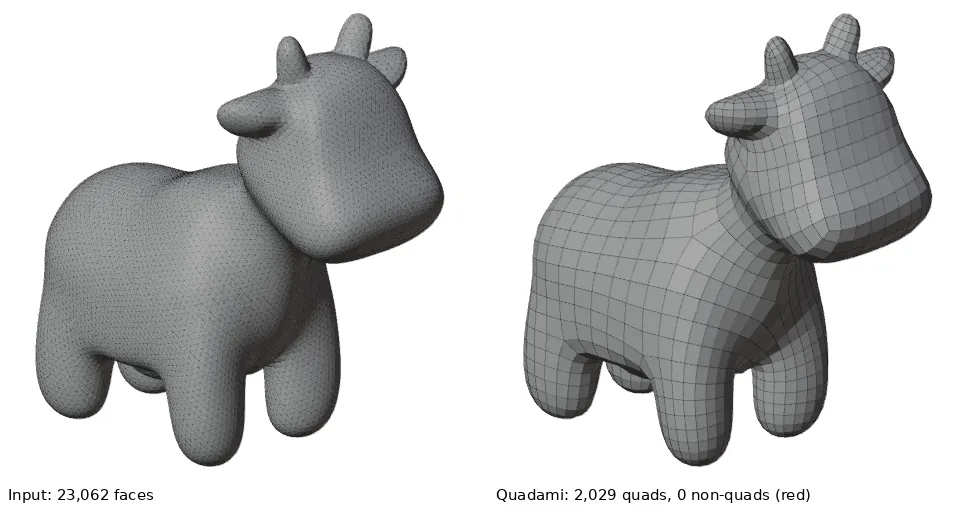
Panel rows flagged: none.
Koala (organic sculpt)
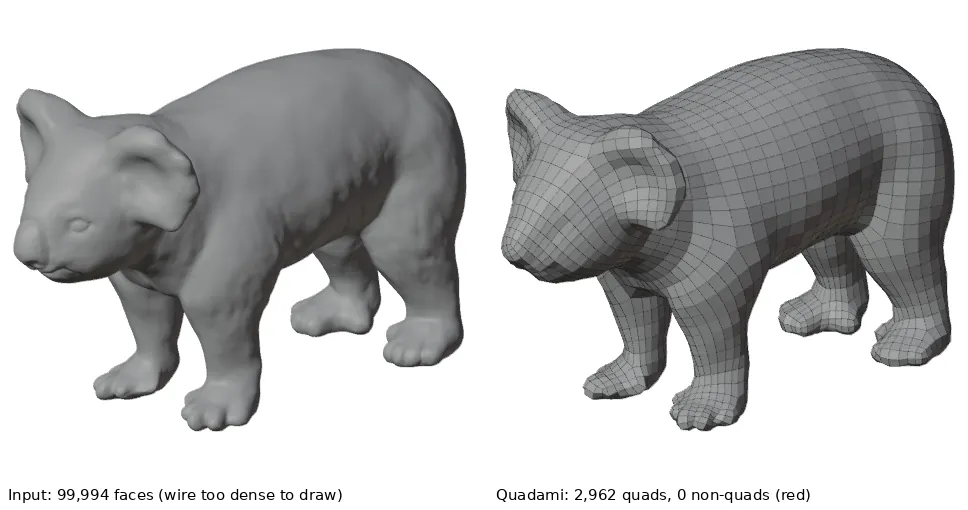
Panel rows flagged: none.
Panel: Folded input: 4 faces in 4 spots, where the surface folds over itself. The quads there may come out messy or with holes.
Wing nut (hard surface)
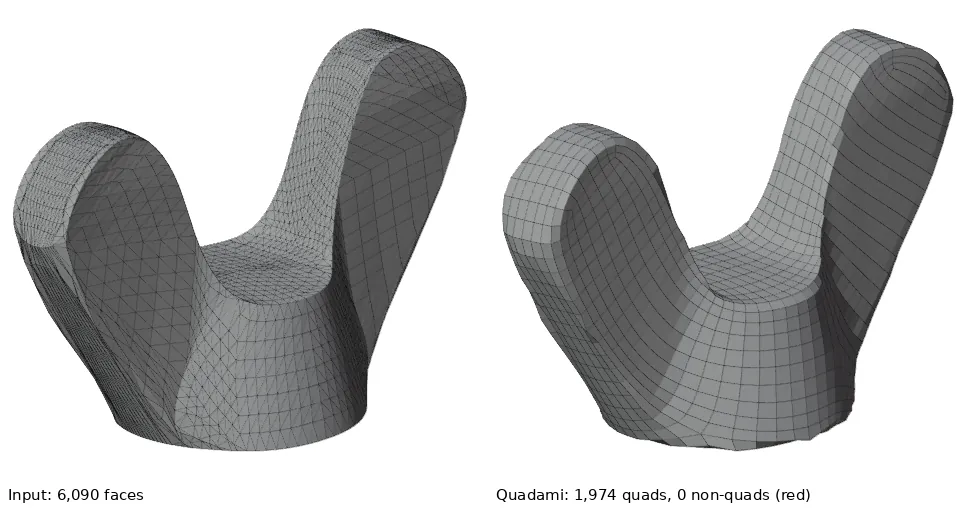
Panel rows flagged: none.
Panel: Folded input: 1 faces in 1 spots, where the surface folds over itself. The quads there may come out messy or with holes.
Boat (panels and sharp rims)
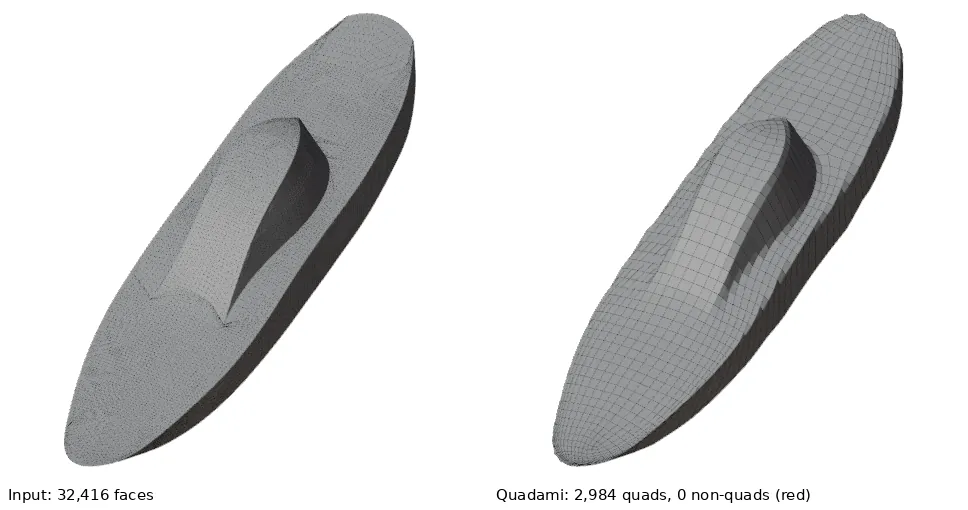
Panel rows flagged: none.
Panel: Folded input: 4 faces in 2 spots, where the surface folds over itself. The quads there may come out messy or with holes.
Demosthenes (photoscan, open base)
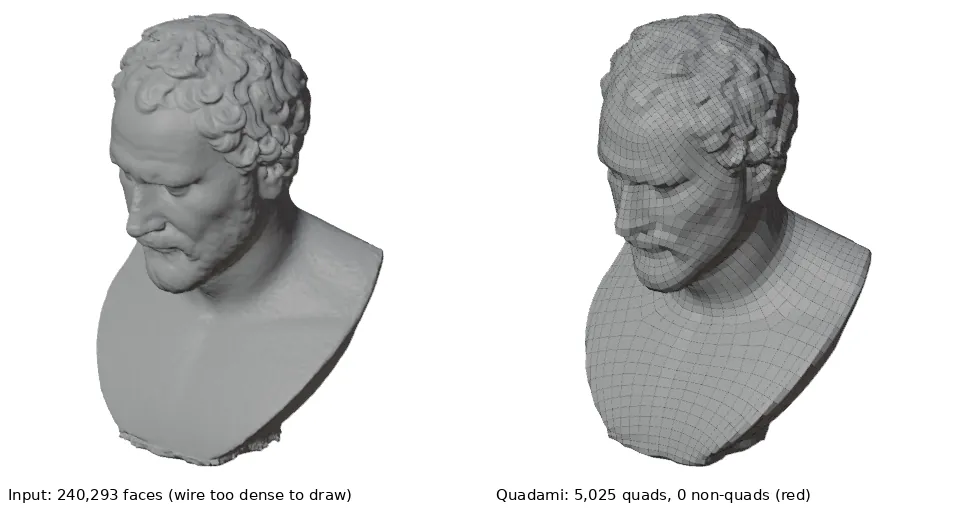
Panel rows flagged: Handles: 3 lost.
Panel: Output has 3 handles fewer than the input (tunnels or loops closed up, on 1 island): handles only a few quads around close up. A higher Target Quads keeps more of them Panel: 1 % of the surface (20 spots) is thinner than one quad at 5000 target quads, a limit of Target Quads rather than a remeshing error: expect folds or lost parts there. At least 11000 target quads (an estimate) would fit a quad across about half of it, but each raise also reveals thinner parts, so it can take several raises; thickening those parts also works Panel: To thicken a part: Tab into Edit Mode, select it, press Alt+S (Shrink/Fatten) and move the mouse outwards. Panel: Folded input: 500 faces in 364 spots, where the surface folds over itself. The quads there may come out messy or with holes.
Dyntopo sculpt (procedural)
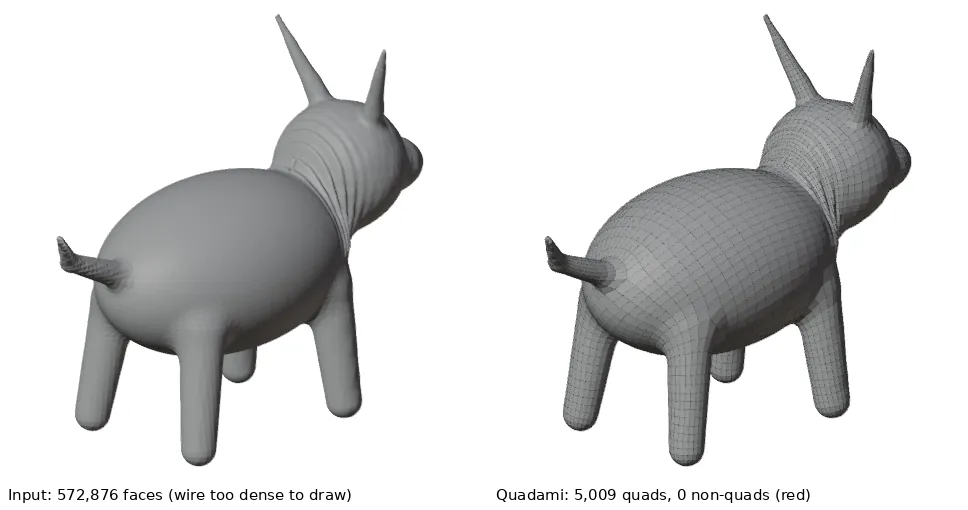
Panel rows flagged: none.
Panel: Folded input: 122 faces in 30 spots, where the surface folds over itself. The quads there may come out messy or with holes.
Sculpted box with folded input
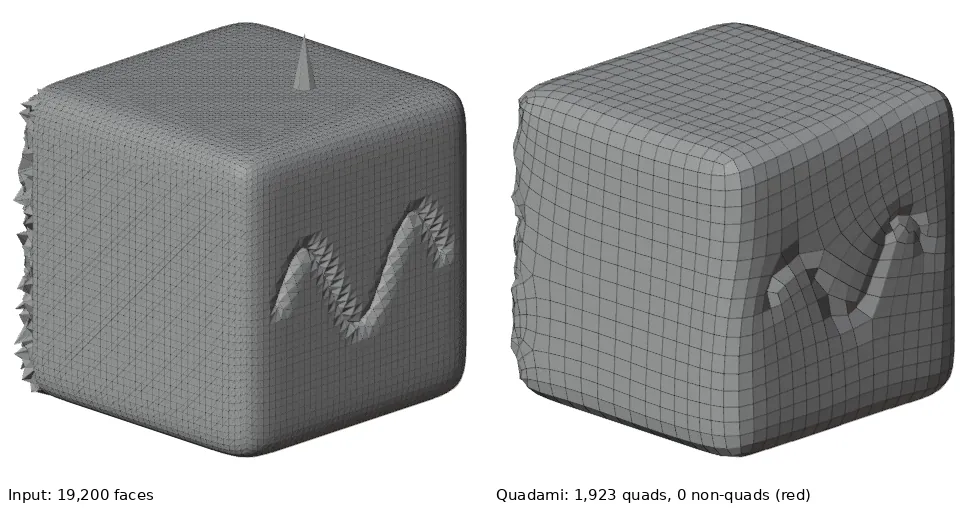
Panel rows flagged: Folded faces: 1; Missing parts: up to 3 quad widths.
Panel: Parts that are not thinner than a quad are missing (up to 3 quad widths away), so Target Quads may not be the cause. If raising it does not bring them back, please report it. Panel: 4 % of the surface (4 spots) is thinner than one quad at 2000 target quads, a limit of Target Quads rather than a remeshing error: expect folds or lost parts there. At least 9800 target quads (an estimate) would fit a quad across about half of it, but each raise also reveals thinner parts, so it can take several raises; thickening those parts also works Panel: To thicken a part: Tab into Edit Mode, select it, press Alt+S (Shrink/Fatten) and move the mouse outwards. Panel: Folded input: 91 faces in 26 spots, where the surface folds over itself. The quads there may come out messy or with holes.
Same box, Repair Folds on
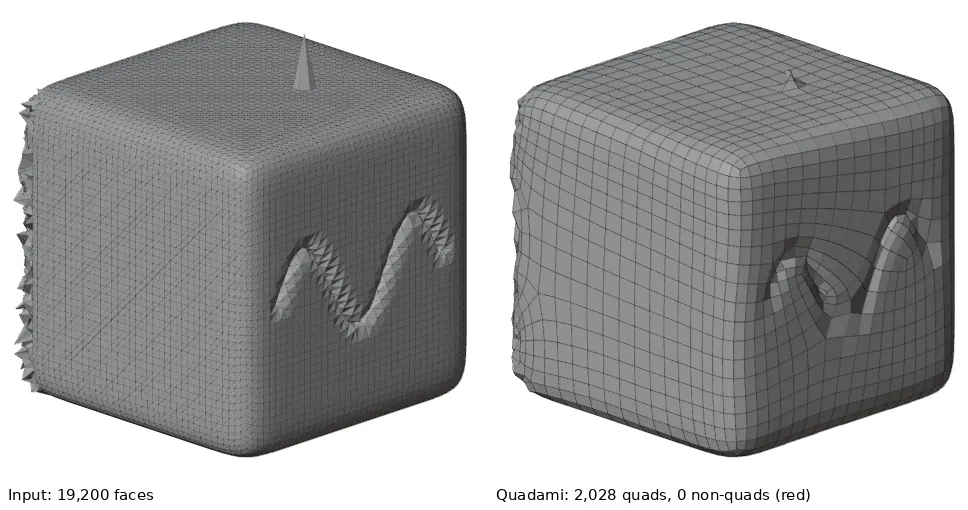
Panel rows flagged: Folded faces: 1; Folds left: 16 faces in 14 spots.
Panel: 16 folded faces in 14 spots could not be repaired safely and were left as they were.
Arming sword at 1,000 quads (thin parts)
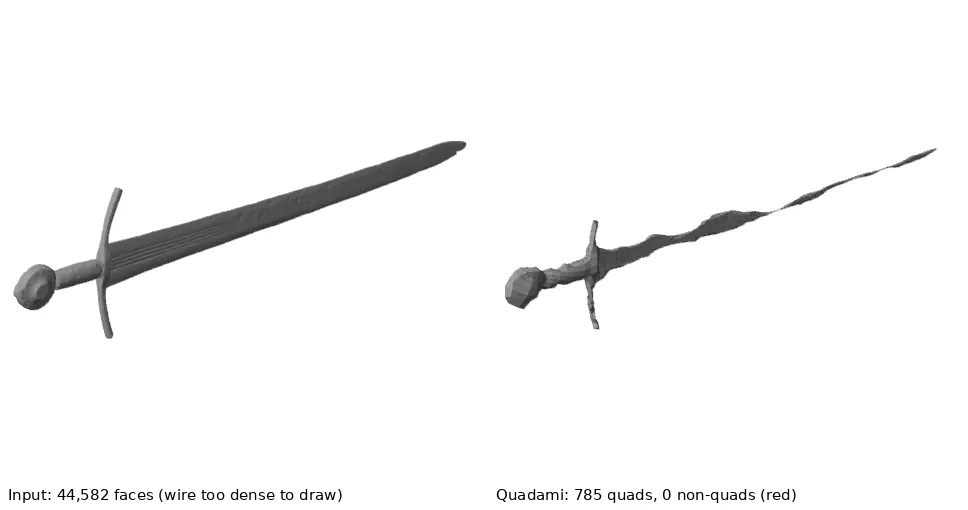
Panel rows flagged: Folded faces: 16; Missing parts: up to 5 quad widths.
Panel: Parts thinner than one quad are missing (up to 5 quad widths away). At 1000 target quads there is no room for them: a limit of Target Quads, not a remeshing error. Raise Target Quads (1.5 to 8 times as many brought such parts back on most test models), though each raise can show finer parts still too thin; or thicken them. Panel: 75 % of the surface (2 spots) is thinner than one quad at 1000 target quads, a limit of Target Quads rather than a remeshing error: expect folds or lost parts there. At least 7600 target quads (an estimate) would fit a quad across about half of it, but each raise also reveals thinner parts, so it can take several raises; thickening those parts also works Panel: To thicken a part: Tab into Edit Mode, select it, press Alt+S (Shrink/Fatten) and move the mouse outwards. Panel: Folded input: 110 faces in 69 spots, where the surface folds over itself. The quads there may come out messy or with holes.
Same sword at 3,000 quads
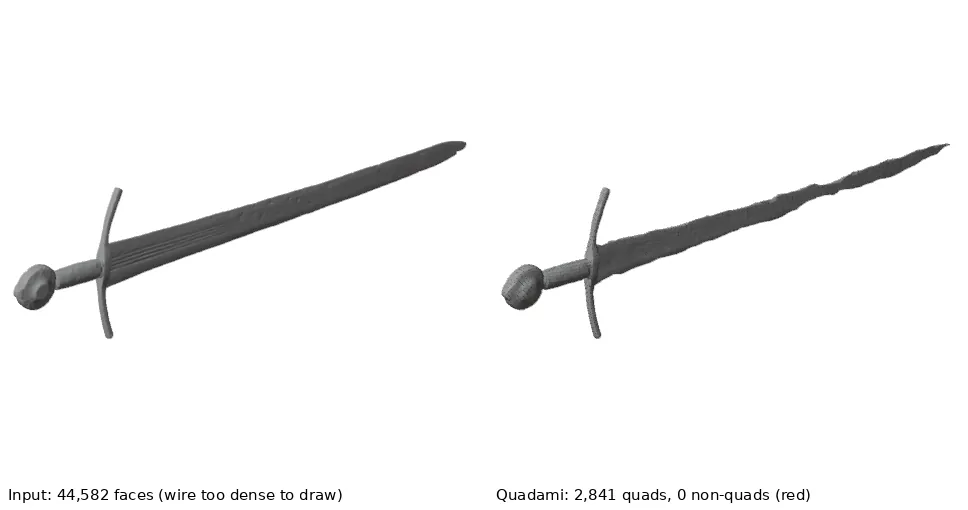
Panel rows flagged: Folded faces: 5.
Panel: 68 % of the surface (4 spots) is thinner than one quad at 3000 target quads, a limit of Target Quads rather than a remeshing error: expect folds or lost parts there. At least 12000 target quads (an estimate) would fit a quad across about half of it, but each raise also reveals thinner parts, so it can take several raises; thickening those parts also works Panel: To thicken a part: Tab into Edit Mode, select it, press Alt+S (Shrink/Fatten) and move the mouse outwards. Panel: Folded input: 110 faces in 69 spots, where the surface folds over itself. The quads there may come out messy or with holes.
Cat (dense sculpt, 1.7M triangles)
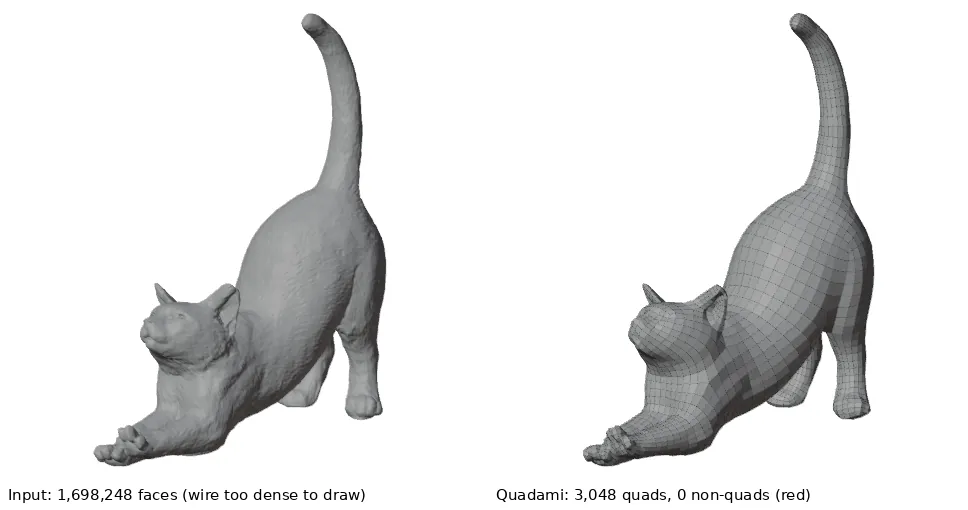
Panel rows flagged: none.
Panel: Folded input: 137 faces in 34 spots, where the surface folds over itself. The quads there may come out messy or with holes.
Hammer (raw scan)
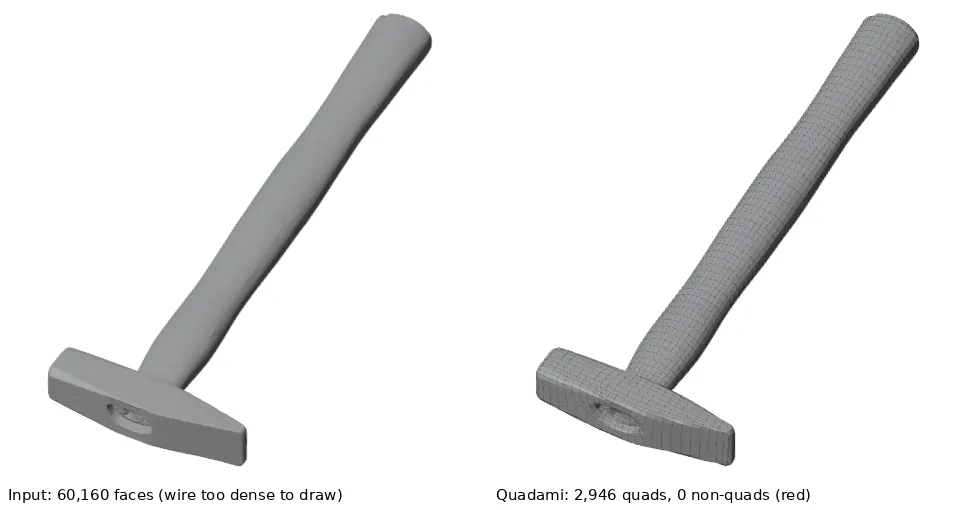
Panel rows flagged: none.
Panel: Folded input: 35 faces in 31 spots, where the surface folds over itself. The quads there may come out messy or with holes.
Plane (thin wings)
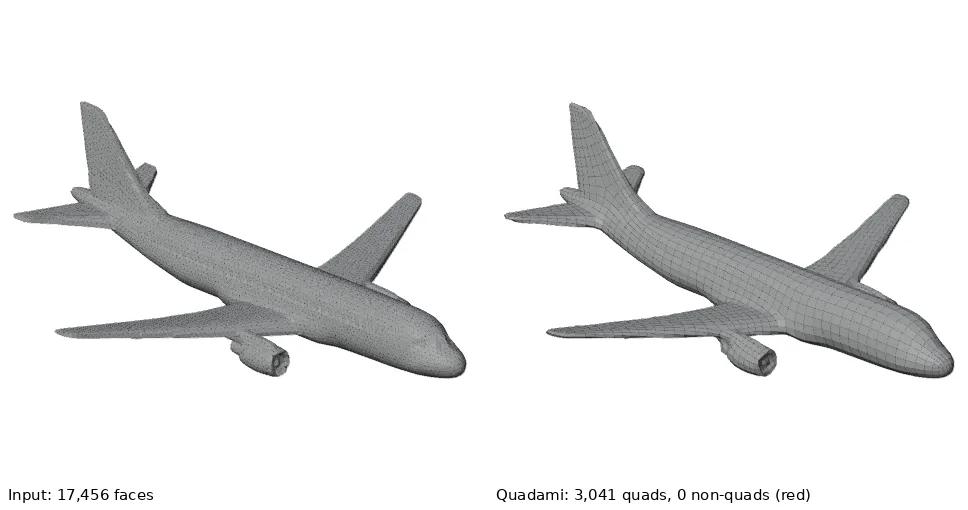
Panel rows flagged: none.
Panel: 10 % of the surface (19 spots) is thinner than one quad at 3000 target quads, a limit of Target Quads rather than a remeshing error: expect folds or lost parts there. At least 4400 target quads (an estimate) would fit a quad across about half of it, but each raise also reveals thinner parts, so it can take several raises; thickening those parts also works Panel: To thicken a part: Tab into Edit Mode, select it, press Alt+S (Shrink/Fatten) and move the mouse outwards.
Limits and what the panel should say
Seeds for a limits page and for the panel's warnings, from the runs above. Measured means in the
table or the run folders; proposed wording is a suggestion, not implemented. Nothing below
claims a fix. Written at 0e9bec8; since then item 1 has a panel warning (thin parts and missing
parts, user guide §6).
- Thin parts lose shape silently. The sword at 1,000 quads: in all 5 runs part of the guard or the blade tip is missing or shortened (shape error 2.0-29.7 % of the diagonal; the other meshes stay at or below 0.2 %). The panel shows only "Folded faces: 11", no holes, no warning, and the topology still matches the input, so no existing check notices. At 3,000 quads the guard is back, but the blade is ragged near the tip (1.0-1.1 %). Measured. Proposed warning, once the core reports a shape distance: "Parts of the result are far from your mesh (up to N % of its size), usually parts thinner than a quad. Raise Target Quads, or thicken the part (Solidify)." Needs a distance check in the core; its cost on dense inputs is not measured yet.
- The folded-input warning fires too often and names the wrong cause. It appeared on 8 of the 10 runs (all but Spot and the repaired box), including the wing nut (CAD, 1 folded face) and the koala (4 faces), whose outputs have no defect in any of the 5 runs, and the Demosthenes photoscan (629 faces in 400 spots); its text blames "a sculpt brush" on scans and CAD parts, and says "1 faces in 1 spots". Measured. Proposed: show it only above a size or count threshold that predicts a defect (to be fitted on the brush and sculpt sets), say "Folded input (faces that turn back over their neighbours)" without naming a tool, and fix the plurals.
- Repair Folds leaves spots and can count wrongly. On the sculpted box it cleared the output
folds (1-3 to 0 over 5 runs) but left 19 of 26 input spots, and the spike on top stays. On
brush_layersat 5,000 (pleats; brush set, not in this gallery) the repair split 3 spots into 32 smaller ones, and the panel row reads "Folds repaired: -29 of 3 spots" (report.py subtracts the after count from the before count). Measured on one run; the arithmetic is deterministic. Proposed: report "N of M folded faces repaired" (faces, not clusters), and never a negative. - Non-quads on sharp rims flip with noise. The boat gives 0 to 6 non-quads and 0 to 3 folded faces over 5 inputs that differ by one ulp. Measured. Proposed wording for the guide: "A few triangles or pentagons along sharp edges are normal; running again with Target Quads a little higher or lower usually changes them."
- Counts land near, not on, the target. 619-871 quads for a 1,000 target on the sword, 94-102 % elsewhere. The panel already shows the percentage; the guide should say thin parts get fewer quads than asked.
Sources and licenses
The downloaded meshes shown here come from odedstein/meshes
pinned at commit 8352132 (tools/bench/fetch_meshes.sh, SHA-256 in tools/bench/meshes.tsv).
License as stated in each object's README there, read on 2026-10-22. Renders of a CC BY mesh are
adaptations: they need the credit below, a link to the license, and a note that it was changed
(remeshed).
| Mesh | Author / source | License (per odedstein README) | Note |
|---|---|---|---|
| spot | Keenan Crane | Public domain (author's dedication) | |
| koala | YahooJAPAN, thingiverse 182225; remesh by Oded Stein | CC BY 3.0 | |
| wingnut | Oded Stein, Eitan Grinspun, Keenan Crane | CC BY 4.0 | |
| boat | Oded Stein, Eitan Grinspun, Keenan Crane | CC BY 4.0 | |
| demosthenes | ryanfb, Sketchfab "Louvre Demosthenes photoscan"; modified by Oded Stein | CC BY 4.0 | The statue is ancient; the license covers the scan. |
| sword | The Oakeshott Institute, Sketchfab "Moonbrand" arming sword; modified by Oded Stein | CC BY 4.0 | Not related to any private sword model of the project. |
| cat | billyd, thingiverse 1565405; remesh by Oded Stein | CC BY 4.0 | |
| hammer | Andrea Spognetta (Spogna), Sketchfab "Hammer rawscan"; modified by Oded Stein | CC BY 4.0 | |
| plane | YahooJAPAN, thingiverse 182252; remesh by Oded Stein | CC BY 3.0 |
Procedural meshes are generated by our GPL scripts from code alone, so their renders carry no third-party
license: sculpt_dyntopo (tools/bench/make_sculpt.py), brush_box_relief
(make_sculpt.py --set brush), and make_synthetic.py's meshes. Blender's Suzanne (make_suzanne.py)
is left out: renders of it are common, but its license status was not checked.
Credits for the images on this page: spot by Keenan Crane (public domain); koala by YahooJAPAN, CC BY 3.0; wing nut and boat by Oded Stein, Eitan Grinspun and Keenan Crane, CC BY 4.0; Demosthenes photoscan by ryanfb, CC BY 4.0; "Moonbrand" arming sword by The Oakeshott Institute, CC BY 4.0; cat by billyd, CC BY 4.0; hammer by Andrea Spognetta, CC BY 4.0; plane by YahooJAPAN, CC BY 3.0; all via github.com/odedstein/meshes, remeshed by Quadami. The images themselves are offered under the same licenses as their meshes.
Rebuild
python3 -m pip install bpy==5.2.2 numpy pillow scipy libigl scikit-image   # Python 3.13
W=~/ar-work
tools/bench/fetch_meshes.sh $W/meshes
python3 tools/bench/make_sculpt.py --out $W/meshes/sculpt --only sculpt_dyntopo
python3 tools/bench/make_sculpt.py --set brush --out $W/meshes/brush --only brush_box_relief
python3 tools/bench/ab.py build master --work $W --jobs 4    # optional: gallery.py builds with 1 job
python3 tools/gallery/gallery.py --ref master --work $W      # about 10 minutes on 4 cores
On Linux without a display, bpy's Workbench renderer needs libegl1. The entries (mesh, target,
camera, title) are the gallery set in tools/bench/corpus.json; --only a,b re-renders single
entries without touching the table. Images are WebP, 968 x 510, about 30 KB each.